Thursday, March 27, 2025
Museo Larco
Rafael Larco Hoyle began collecting ancient Peruvian items when his father presented him with his first piece when he was 26. He began collecting other items, soon gathering up collections from throughout northern Peru. Surprised by the lack of archaeological cataloging of found items, he chronicled his collection, which is now online and available to all who wish to use it.
The museum is a spectacular example of the early culture of Lima, the way they buried their elite, the human sacrifices made, and the quality of their textiles and their metallurgy, not to mention their skill at making pottery.
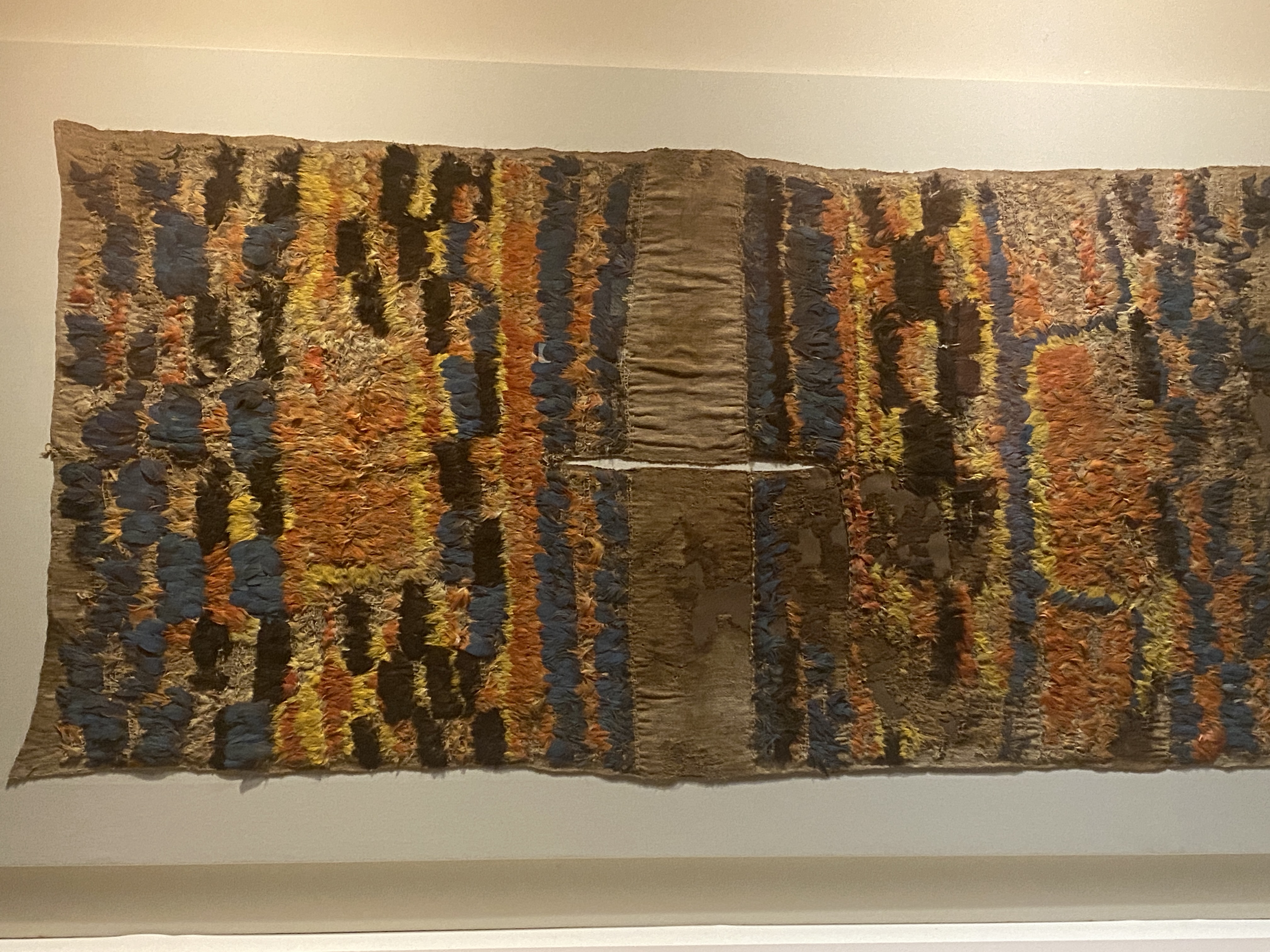
Larco took great care in cataloging each piece and in ensuring the safety. Very few of the pots have even one chip out of them, and the colors are quite vibrant. The feathered tunics and blankets, although dusty when found, were returned to their natural colors when carefully washed. Because the Limans were not a warring society, by the time the Spaniards arrived, much of the pyramid was covered and so no one had looted the tombs, which gave Larco a chance to recover many items. Although he sold many of the artifacts, he kept many more, and now Lima has the benefit of his private collection, still in the family name. His grandson is now studying archaeology to help further the cause.
Herding Cats
When I talk about herding cats, one might think I am referring to our tour group, which indeed might qualify. But instead, I am really talking about cats.
We visited Kennedy Park in Lima, which is a small green space in Miraflores. Besides being across the street from the City Hall, it is known for its cat population. The cats had become such a problem, that the district made a plan with local cat enthusiasts to help solve the problem.
Now this group of volunteers takes care of the cats. They built shelters for the cats, they spay and neuter, they feed, and generally they make sure the cats do not overpopulate the park. The cats keep the rat population down, they wander around so people can pet them, and generally they lead a good life. What a great way to take care of the feral cat population, at least in this one small location.
The Fish Market
Our first stop on Tuesday in Lima was to an artisan fish market. We learned that most local fish is purchsed from local fishermen who take their small boats out - using oars, not motors - to catch their fish. The commercial fishermen must stay five miles offshore, and their catches are used commercially. The local fishermen take their boats within five miles of the shore, and they bring their catches to one of number of these artisenal fish markets.
We watched a woman filet numerous mullets while we talked with her. She has to pay a fee for the space she is using, and a good day for her is usually 30 soles - $10. Her fee, if I recall correctly, is 5 soles - about $1.66. And she works very hard. Tedious, hard on the hands, standing the whole time - yikes!
We visited with a fisherman who was repairing his nets, which is a daily occurrence. Seals and turtles are the main ones who damage the nets, but bigger fish can do so, too.
Along the sidewalks are many food stands, which are the businesses for the people in the area. Only 20% of those who live in Lima are "official workers," in other words, those who earn salaries, have benefits, and pay taxes. The remaining are unofficial and they have to find a way to feed their families. Many of them set up their stands to sell foods, items for the beach, trinkets, and the like. Some of them have small seating areas where people can purchase their items and eat; others do not. We saw one "sandwich," which was a roll with a fried fish in it, the tail still attached and sticking out. We wanted a picture but were denied. More later about the 80%.
Adobe, Peruvian Hairless Dogs, and other Facts
Since my heritage is New Mexican, when I heard about the pyramids at Huaca Pucllana being made of adobe, I listened hard. And yes, it is adobe, but because there is no rain in Lima, some has lasted over 1500 years. And it is not made with straw or any live plants - strictly clay, water, shells, and rocks. It is estimated that many millions of blocks were made to complete the whole structure - over 400 years. That is a lot of construction!
In order to survive in Lima, the original settlers needed to figure out how to eat. They built ditches from water sources in the Andes, and they irrigated numerous crops. Besides potatoes, beans, Lima beans, and corn, they also grew four different colors of cotton. I didn't know cotton even had different colors other than natural dyes! Alpaca and llamas were also prevalent, as well as guinea pigs - I think we get to sample that in a few days.
And finally there is such a dog as the Peruvian hairless dog. They use them for guard dogs, and although they are friendly, if someone strays into their territory, they aren't so nice. All I could think about is the litigation that would occur in the US if we let guard dogs run amongst the visitors. But if someone needs a hypoallergic dog, this one might be the one.
Huaca Pucllana
As one approaches the Huaca Pucllana site, in the middle of numerous high-rise buildings, the enormity of the effort is not readily apparent. In some ways, it just looks like a mountain of mud - which is sort of is - until you get close. And then . . . it begins to unfold.
Built about 500 AD, this large, 18-hectar pyramid had been hidden under a mound (it was a motocross practice area for kids in the 1960) until 1980, when Isabel Flores Espinoza convinced the authorities that some excavation needed to be done. By 1984, some of the excavation began, and from April to October every year, archaeologists continue to uncover miraculous finds. Due to buildings surrounding it, only 6 hectares remain.
The pyramid was primarily a sacred site and burial area for the Lima, who built it over about 400 years, partially as a tribute to the ocean, as evidenced by the iconography that consists of sea creatures, but especially of sharks. Then another tribe, the Huari, took it over, and then it was occupied by the Uchsma until the Spaniards arrived. It fell into disrepair and gradually disappeared from Peruvian life.
The pyramid is constructed strictly of adobe, made from clay, water, seashells, and rocks. What is particularly notable about it is that the blocks are laid as if they are on a library shelf. Why? Earthquakes. Lima has many small tremors, and this construction weathers the tremors better than laying them like bricks. And they figured that out 1500 years ago!
Evidently it was used for the elites of the culture, and numerous high-society members were buried there. Excavators have found many tombs, consisting of a mummy that is wrapped in leaves and textiles with a fake head on top, surrounded by many gifts and frequently sacrificed children. Tombs have had up to 8 children buried in the tombs, but the archaeologists have yet to determine who the children are (family members, friends, or others) and why they are sacrificed.
One stunning observation is how many of the pots and tombs are totally intact. It appears as if the site was just allowed to drift into oblivion and it was not looted or ruined by conquerors. So many other archaeological sites consist of broken pots put back together, but many of the pots in this exhibition are very large and in perfect shape. And the mummies are totally undisturbed. What a treasure Huaca Pucllana is!
Monday, March 24, 2025
Lima - Day 1
After an easy 6 hour flight to Lima (Long enough for two good movies) we were met in Lima and taken to our hotel. It was 10:00 at night on a Sunday, but the traffic was still bad. Glad we are not trying to drive.
There will be several challenges on this trip including altitude and snorkeling. But the two daily challenges that I will have are not to drink the water (even to brush teeth) and not to send toilet paper down the toilet. That one is really tough to remember . . . I know other people have goofed up on this one, too . . . but my percentage of "rememory" is not very good right now.
Anyway, maybe TMI, but that is the reality of travel. Jim and Jenni Moore are traveling with us, and they are very easy to travel with! In Lima, we snagged two of the four penthouse rooms - lucky us. The room is very nice, the A/C works well, and after we got the safe to work (glad my Spanish is still ok), we are set for two nights.
After an orientation meeting, we walked to lunch where the choices were much different from anything we have experienced but they were good. I had mashed potatoes with chicken inside (on the right - the yellow round patties are the mashed potatoes), and Don had fried potatoes with yellow chile sauce. Both were not seasoned very heavily, but they were certainly easy to eat. For a diverse group like ours, having several choices was perfect.
Then I had a fish dish and Don had a beef stir-fry, and for dessert we have a small slice of apple pie with really good vanilla ice cream on top - with chips of vanilla in the ice cream.
We then walked through the Miraflores district of Lima - the more affluent area, where most of the houses and apartment buildings are fortified by electric fences and alarms. Our guide, Cesar, says it is a safe area, but as we find at home, crime can hit anywhere, and it has moved into the Miraflores area. It is a very pretty housing district, however, and the stores are quite pricey. We then went to our first archeological site, Pucllana. More in the next post.
Wednesday, March 19, 2025
Preparing for Peru
Although we had not planned to take another trip to the Southern Hemisphere, when the tour to Machu Picchu and the Galapagos came up, we decided we had to go. So here we are again, trying to pack for 18 days into a carry-on and a backpack. We will make it . . . but it will be tight.
In the meantime, we have had the cruelest weather in Wichita . . . really cold for weeks, then 71 mph winds and dust storms last week, then 75 - 80 degrees Monday and Tuesday of this week, and now snow and howling winds again. Oh my.
I must say, we are looking forward to seeing what the weather is like near the Equator, in the Andes, and on the coast. It should be a fun trip . . . stay tuned!
Subscribe to:
Posts (Atom)