Tuesday, April 8, 2025

The Galapagos Tortoise

When one thinks of the Galapagos Islands, I suspect most of us think of the giant tortoises. We went to visit a preserve where many live, though they are free to roam off and on the property.The property is fenced with barbed wire, but the managers make sure the bottom wire is high enough that the tortoises do not get tangled in it. He longest-living tortoise that we know of was named Harriet, and she was nearly 200 years old when she died a few years ago in Australia. At one time Harriett was owned by Steve Irwin. We were able to see a number of very large turtles, though no one really has much idea how old they are . . . and tracking them really doesn't work well, because they live longer than the batteries in the tracker and the people who are trying to study them. Apparently the turtles need to eat food that is half of their weight - daily - and once the guava tree was introduced, they have no trouble liking their food. They also eat grass and other things, but they love the guava. They walk using both front feet at the same time, which looks awkward, but it works.
The younger turtles still have the concentric circles or squares on their shells but as they age, the shell becomes more shiny because the circles smooth out from the friction of the bushes. In the pictures above, one of the turtles is older, as evidenced by the lack of concentric circles on the back.The turtles do not have diseases so they either die of old age or sometimes when they are mating they flip over, and if no one can turn them over, they die. The fine for hitting a turtle on the road is upwards of $30,000, so those who have cars drive very carefully. Turtles can also overheat, so they try to find water puddles on hot days.
I think some of us were ready to join them!

Monday, April 7, 2025

A Galapagos Dog Rescue

Since many in our group are dog lovers and dog rescuers, Alejandra found a way for us to visit the dog rescue in Puerta Ayora. The group began just before the pandemic, when the family realized that there were many abandoned dogs in the city. During the pandemic it got worse, and they continued to try to help with the dog population.
The very humble business began with just one dog - Juanchito - and now they house over 40 dogs and 30 cats, either at their facility or in foster homes. It is not an easy job in a culture like the Ecuadorian, as animals are typically not considered as important. But this family believes strongly in what they are doing, and they make sure their snimals are spayed or neutered before they are adopted out. The only requirement they have for families who take the dogs is that the people have a house with a fenced yard. Their primary cost is food, but they have many other costs as well. They receive some help from international foundations, and our group did donate some to them, too. They are doing good work, and I hope they are able to continue doing so.

An Entrepreneur Extraordinaire

Many years ago a young man, Adriano Cabrera, arrived in the Galapagos with only one sucre (the currency at the time) in his pocket. He was determined to make a life for himself, and he began to farm and work. Now, at 84 years old, he is still running his business, and it is the most extraordinary farm I have ever seen.
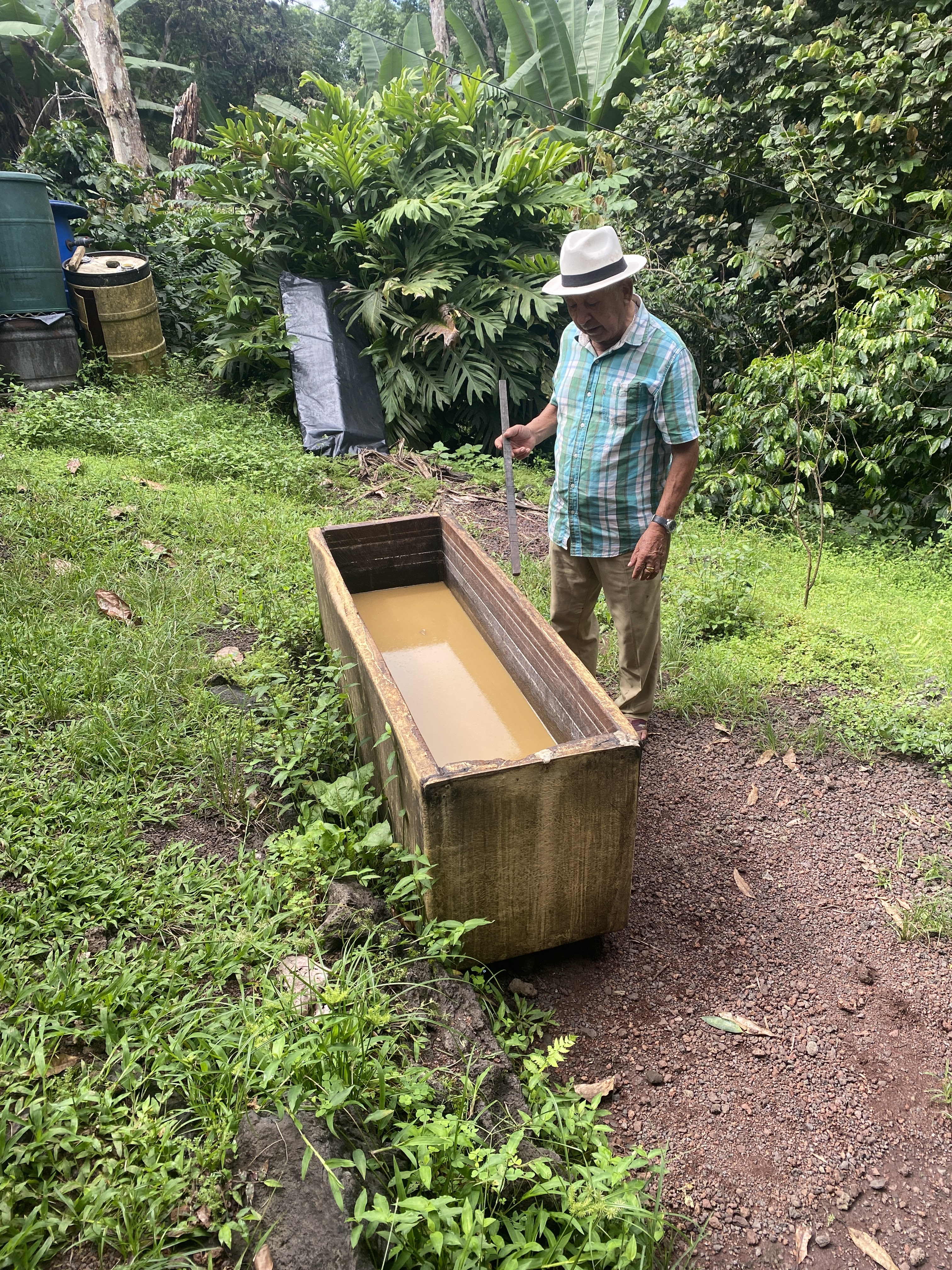
First, he showed us how he extracts sugar juice from sugar cane. It is a process done by hand, using a large piece of wood that he turns by hand. At times he would use a donkey to turn it, but frequently he or his family would turn it themselves.
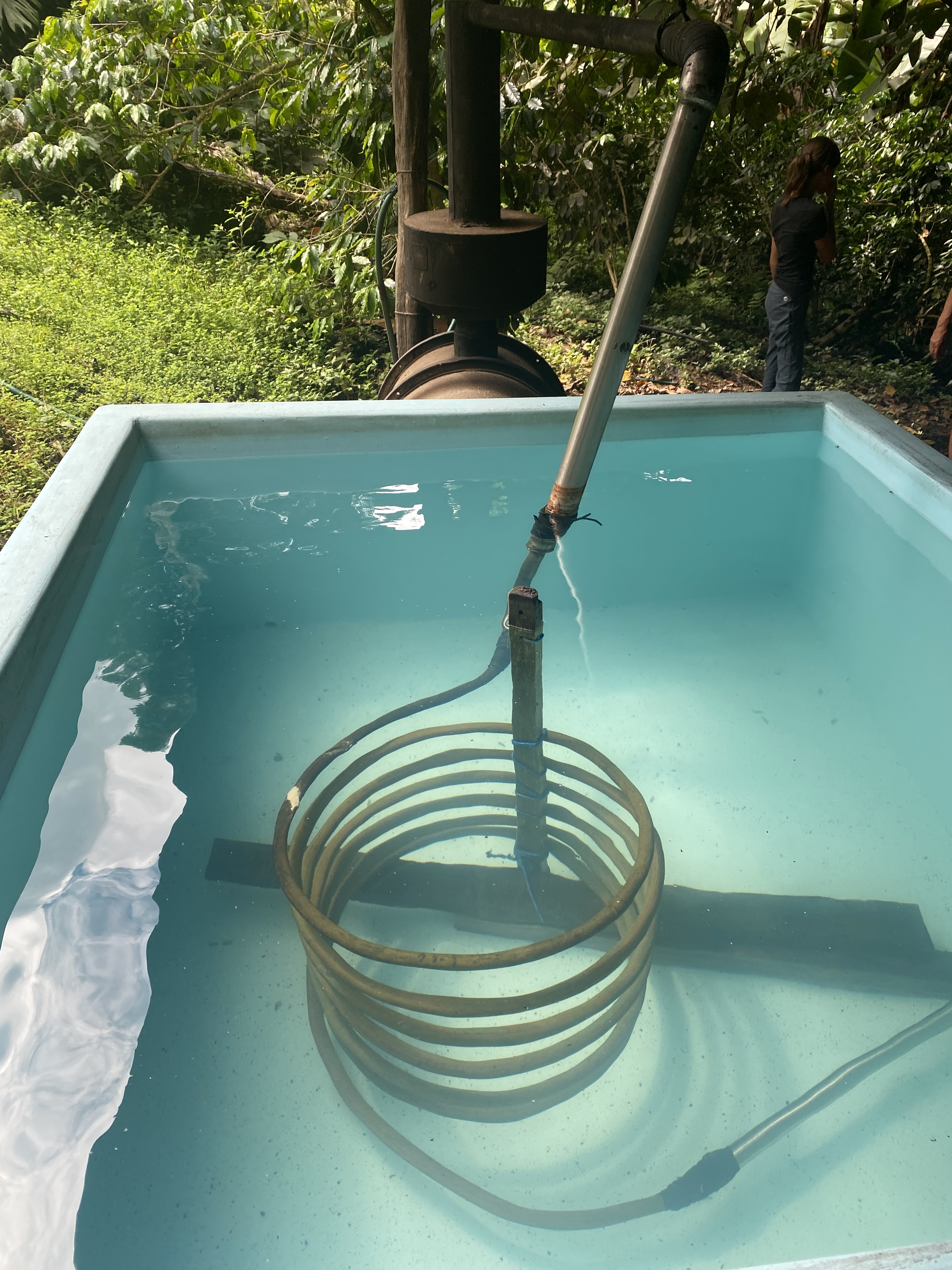
Then he takes the sugar cane, ferments it with a bacteria for 24 - 48 hours, boils it, collects the condensate and creates alcohol that is 50% proof. He makes two different kinds - anis and regular - but I have no idea what to call it - maybe a liqueur? We tasted it, and it had quite the kick, at least to me. His still looks like it belonged in the swamps of Kentucky during Prohibition.
He also grows coffee, and he showed us how he dries the coffee beans (originally they look like red cherries)in the sun for several weeks, then he crushes the beans to get the husk off the beans. Using a hand fan, he then separates the husk from the bean. Finally, he roasts them over a small fire while pushing the container back and forth over the fire. He does what he calls automatic, using a rope that keeps it swinging. Once they are roasted, he bags the beans for coffee. Don really liked the coffee, and hence, we are taking home two bags of it.
We were treated to bananas fresh off the tree (similar to eating pineapple in Hawaii - much better than eating them in Kansas), and we learned a little about his production of chocolate, too. One interesting aspect of his farm is that his crops are intermixed. This avoids many pests that might take out a whole crop if planted together, and it allows for the mixing of tastes in the fruits.
Such a fascinating business, still done the old-fashioned way - and quite successful doing it that way.

Sunday, April 6, 2025

Things that happen only on the Equator

While we were on the boat we learned about some other interesting facts of being near the equator. Besides water going down drains in opposite ways in each hemisphere but going straight down on the equator, we balanced an egg on a nail, tried to stand on the line with our eyes closed, and experimented with other phenomenon. Alejandra also told us why Ecuador does not experience hurricanes or cyclones. The currents in the Pacific ocean that affect the equator are the Humboldt, the Panama, and the Cromwell. The Humboldt and the Panama are in the southern hemisphere and the Cromwell in the northern hemisphere come together, they cancel each other out so that a hurricane or a cyclone cannot form. This is the Coriolis Effect, and at the equator the Coriolis force is zero - hence no rotation! Physics - wish I had taken it as a course.

Snorkeling

It has been a lot of years since we have snorkeled, and I could tell. The first time I dropped into the water, panic swept over me. I had forgotten what to do. Luckily, Alejandra had a life saver that she let me use, and I put it in front of me and paddled along. That worked well, and I was able to see many fish I had only seen in aquariums. We came upon some fur seals and some Galapagos sea lions, and they came into the water and swam with some of the snorkelers. Some of the fish has gorgeous colors, but my favorite was the small cobalt-colored fish that may have been a baby wrasse.
We chose not to go on the second snorkel where some saw a hammerhead shark, but the next day we chose to try it again. Much easier this time. We were again treated to seals, marine iguana, ghost crabs, anemones, sea urchins, star fish, white-tipped sharks, and numerous other fish. What a difference between today and yesterday. Thoroughly enjoyable. My favorite part of the whole experience, however, was watching Alajandra dive below and swim through a school of fish. She was so very graceful and experienced . . . we were lucky to have her as our guide!

Frigate Birds

Frigate birds are probably the most interesting birds we have seen. They have scissor tails, much like a swallow, but they are very large birds. They fly incessantly, looking for food mostly, and they stay aloft for hours. One study in the Indian Ocean tracked a frigatebird aloft for two months. In the Galapagos, two kinds of frigate birds live - the great and the magnificent. The Great Frigate Bird is the most common on the islands where we were, and they have several interesting characteristics. First they cannot get their wings wet, and so they fish by swooping down and snatching fish that have been forced to the surface by other fish. They also are known as pirate birds, as they may steal food from other birds and they occasionally eat other birds' chicks. On one of our trips, a frigatebird was found sitting in the ocean. Alejandra, our guide, seemed distressed, because frigatebirds normally cannot get their wings wet. A large bird came swooping by, and the one in the water flapped its wings and very awkwardly managed to fly to the cliff. Alejandra thought it was probably a juvenile bird, and, encouraged by what we think might have been its mother, it was lucky to have the strength to get out of the water onto the cliff. Disaster averted. The most interesting thing about the frigatebirds, however, is the way the males attract their mates. The males have a red pouch on their throat, and when they want to attract a mate, they inflate the red pouch.
It takes enormous energy for the males to inflate their pouches, and if they do not attract a mate and "abort the mission," the pouch slowly deflates and the bird must wait another year to try to attract a female. The males reach mating age about 10 or 11 years of age, and the females at about 9 to 10 years.
When a female decides to mate with a male, she swoops down next to him, he puts his wing over her, and they engage in what the natives call "honeymooning."
Then they lay their eggs, and after the eggs are laid (which are about 6% of the female's body weight), they take about 4 weeks to hatch, and then the parents spend up to 4 - 6 months taking care of their babies. We also discovered that frigatebirds like to "draft" from ships - we had a few tag along on our final ride to shore.
Seeing all of the red pouches in the trees was quite the experience. We are lucky to have seen so many of them!

Palo Santo - Incense Tree

The Palo Santo, or Incense Tree, is a prolific plant in the Galapagos. It loses its leaves at various times of the year, but it blooms with yellow flowers. The wood is very aromatic, and it smells like frankincense. It is also used as a bug repellant and it is used in religious ceremonies as incense. It can be purchased in the United States as Palo Santo Incense.